 Layerswap
 fees vary by route, and outside provider charges can change the transfer’s full cost
Compare Layerswap fees with the live route quote, then add any transaction fee that an exchange or other sending service collects outside it. Quoted costs can include service, blockchain, and third-party route fees. The quoted receive amount shows the practical outcome, while the minimum receive amount marks the lower boundary stated by the quote. Compare like-for-like routes before committing the source transfer.
Last updated ·
Table of contents
A lower displayed fee doesn’t always produce more destination assets. Keep the source asset, destination asset, amount, slippage setting, and optional refuel choice unchanged while comparing two routes.
Four charge lines shape the full transfer cost
Four potential charge lines can affect a transfer, although a particular route may use fewer. The Layerswap fee is the service’s own charge. Blockchain fees cover required on-chain execution. A route may also involve another provider, while an exchange or external service can impose its own transaction charge.
| Charge line | Who sets or receives it | Where to verify it | When it applies or changes |
|---|---|---|---|
| Layerswap service fee | Layerswap | The service fee and total fee in the route quote | Requoted when the selected route or transferred amount changes |
| Blockchain fee | Network participants or the protocol mechanism defined by the chain | The blockchain fee in the quote or a transaction prompt | Depends on the transaction required by that route and network conditions |
| Third-party route expense | The provider used by the selected path | Provider and expense entries in a detailed quote, when present | Applies only when that provider participates in the path |
| External transaction fee | An exchange or another service used to send funds | The provider’s withdrawal or transaction confirmation | Follows that provider’s supported route, amount limits, and fee rules |
| Comparable transfer cost | All applicable cost recipients | Quoted total and receive amount, plus any external charge | The transfer must remain within route and provider limits |
For a hypothetical same-asset route quoted at a 1:1 rate, 152.42 requested units minus a 1.12-unit total fee equals 151.30 units. If the displayed receive amount differs, don’t replace it with this subtraction. Rate, precision, slippage, or another route field may affect the output, so the quote’s stated result controls.
Before sending funds, save the route, requested amount, fee breakdown, receive amount, and minimum receive amount. If the figures don’t reconcile, request another quote or select a different route while both choices remain reversible. A submitted source transaction can’t be undone through quote comparison. After delivery, compare the received amount and transaction record with the saved quote and any outside charges to confirm the final cost.
Quote fields connect charges to delivered value
The total fee summarizes quoted costs, but it isn’t the only number needed for comparison. Requested amount describes the input, while receive amount states the expected output under that quote. Minimum receive amount supplies a lower output boundary. The rate explains how different asset units relate, and the slippage setting determines the accepted tolerance for a changing conversion.
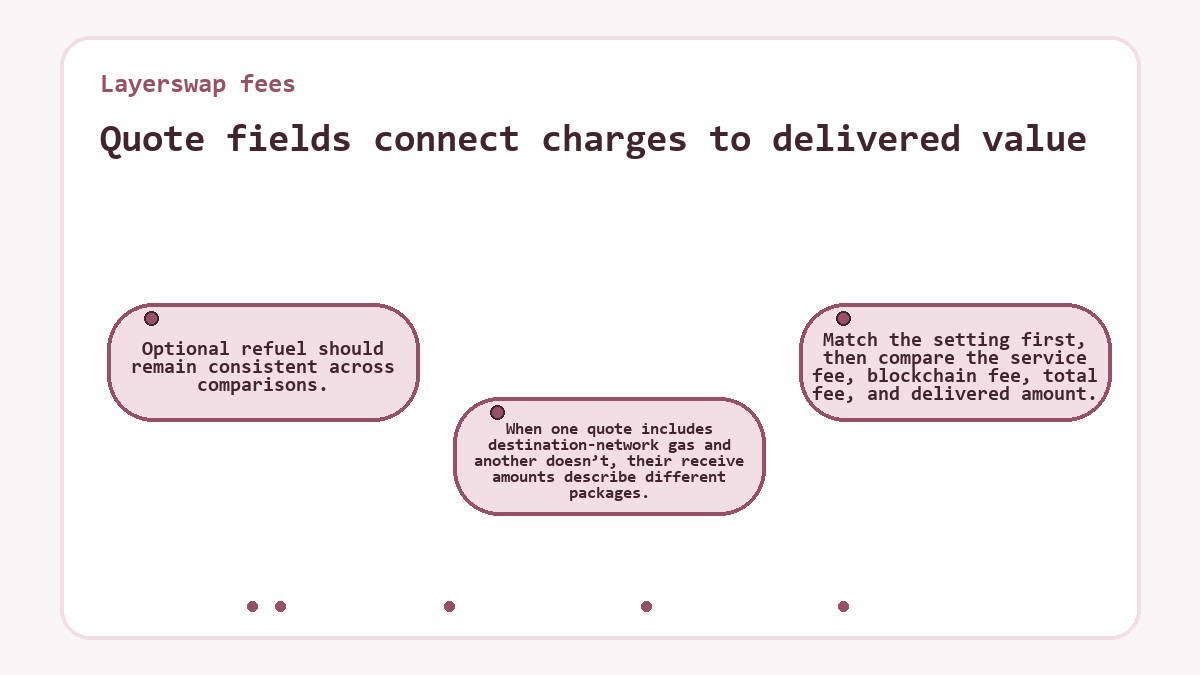
Slippage isn’t a payment to Layerswap or a network participant. It describes potential movement between the quoted and executed conversion. A fee discount is also a quote field, so check whether the shown total and receive amount already reflect it before applying any manual adjustment. Subtracting an included discount twice makes the route appear cheaper than it is.
Optional refuel should remain consistent across comparisons. When one quote includes destination-network gas and another doesn’t, their receive amounts describe different packages. Match the setting first, then compare the service fee, blockchain fee, total fee, and delivered amount.
Fixed and proportional parts respond differently to amount
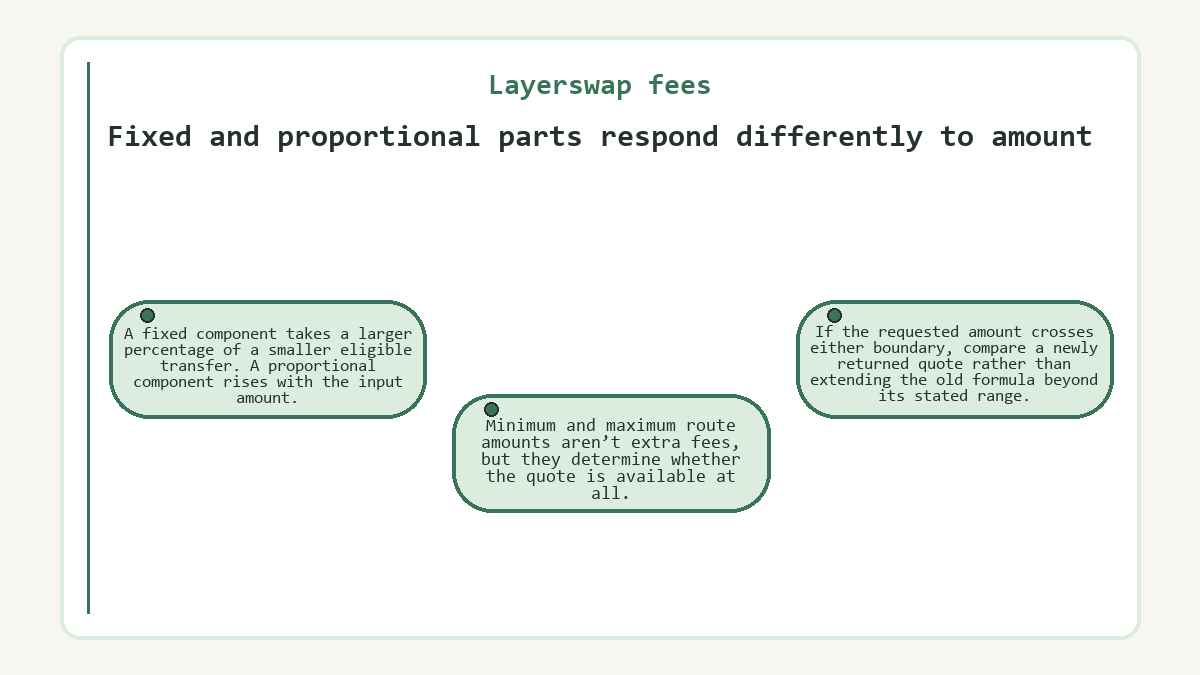
The detailed quote can report route minimum and maximum amounts alongside fixed, percentage, service, and provider expense components. These fields show why changing the transfer amount can alter both the absolute fee and its effective share of the transfer.
Where a route contains a fixed component F and a proportional rate p, its fee relationship can be written as F + (p × A), with A representing the amount. This formula is useful only when the fields share a compatible denomination. It doesn’t replace the receive amount when conversion rates, token precision, or other route adjustments also apply.
A fixed component takes a larger percentage of a smaller eligible transfer. A proportional component rises with the input amount. Minimum and maximum route amounts aren’t extra fees, but they determine whether the quote is available at all. If the requested amount crosses either boundary, compare a newly returned quote rather than extending the old formula beyond its stated range.
Like-for-like quotes reveal the better cost outcome
Start with the amount that reaches the destination, not one isolated fee field. Two paths can report different service or blockchain charges yet deliver comparable outputs because their rates and provider expenses differ. When destination assets differ, token counts aren’t directly comparable. Use a common valuation captured at the same time, while remembering that this valuation can move.
The minimum receive amount adds a second decision point. A larger gap between expected and minimum output allows the executed result to fall farther while remaining within the quote’s terms. That gap isn’t itself a charge, and it shouldn’t be added to the total fee. It shows how far the accepted output may move within the quote’s terms.
Completion estimates can break a close tie, but they aren’t monetary fees. Compare them only after normalizing route direction, assets, amount, destination, slippage, and refuel. If any of those inputs differ, the quotes answer different questions.
External provider charges need their own line
A route may involve a Layerswap fee, a third-party fee, a network fee, and a transaction fee charged by another service provider, including an exchange. The last category can sit outside the Layerswap total because another company sets and collects it.
An exchange withdrawal screen may show a fee or a net amount before the transfer is authorized. Record that figure beside the Layerswap quote rather than assuming it has already been included. The same treatment applies to a separate wallet gas prompt. Keep it as an independent line until the interface clearly shows that the quoted blockchain fee covers the same transaction.
Double counting is the opposite problem. If the quoted total already contains the blockchain or provider expense, adding that field again exaggerates the cost. Reconcile the total against its components, then add only charges collected outside the quote.
A fresh quote preserves choice before funds move
A quote can change when the route, amount, provider path, rate, liquidity conditions, or optional settings change. Since the requested amount is an input to the quote, changing it can affect route availability, fees, and the receive amount. Request a new quote before sending a different amount.
Before submitting the source transfer, request a fresh quote if the amount is out of range or the receive amount has changed. At that point, no blockchain transaction needs to be reversed. Once the source transfer has been initiated, blockchain execution is generally irreversible, and abandoning the browser page doesn’t recover its network fee.
Retain the accepted quote, its fee breakdown, any external withdrawal charge, and the resulting transaction identifiers until the delivered amount is confirmed. If the final record and receive amount disagree with the accepted terms, those records identify which quoted or external component needs reconciliation.
Still wondering about Layerswap fees?
Does requesting a Layerswap quote charge a fee?
No. Requesting and reviewing a quote doesn’t itself submit a blockchain transaction or transfer assets. Costs arise when the chosen route requires execution and the source transfer is authorized. If a wallet prompts for an on-chain action while you are only comparing quotes, inspect that action before approving it because it is separate from viewing the quote.
Can a fee discount be subtracted from the displayed total again?
A fee discount shouldn’t be subtracted twice. Use the total fee and receive amount shown in the returned quote, then inspect the discount field to see how those figures were calculated. If the interface doesn’t state whether the discount is already applied, don’t change the displayed figures manually.
Which amount matters when the source and destination assets differ?
The receive amount is the relevant destination quantity, while the requested amount describes the source input. Because the two assets use different units, subtracting the total fee from the source amount may not reproduce the destination output. Compare alternative routes using the same asset pair, amount, and settings, or convert both outcomes to one contemporaneous valuation.
Are network fees returned after a failed or refunded swap?
Network fees paid for transactions that were executed aren’t normally reversed because they compensate the blockchain’s execution process. A later refund is a separate transaction and may involve another network cost. The refund record and transaction entries should be checked independently from the original Layerswap service fee.
When should the minimum receive amount guide my choice?
Use the minimum receive amount to compare the lower output boundary of otherwise equivalent quotes. It isn’t an additional fee and shouldn’t be deducted from the expected receive amount. A wider difference between expected and minimum output indicates more room for the executed result to move within the quote’s accepted conditions.
Will enabling refuel change an otherwise identical quote?
It can. Refuel adds destination-network gas as part of the requested package, and the quote can represent its amount separately. Compare routes with refuel either enabled on both or disabled on both. Otherwise, the totals and receive amounts cover different outcomes even when the source, destination, token, and transfer amount match.
Which fee records should I retain after submitting the transfer?
Keep the accepted route quote, requested amount, service and blockchain fee fields, receive and minimum receive amounts, external provider charge, swap identifier, and transaction identifiers. Together, these records show which cost was quoted, which service collected an outside charge, and whether the delivered amount matches the completed transfer.